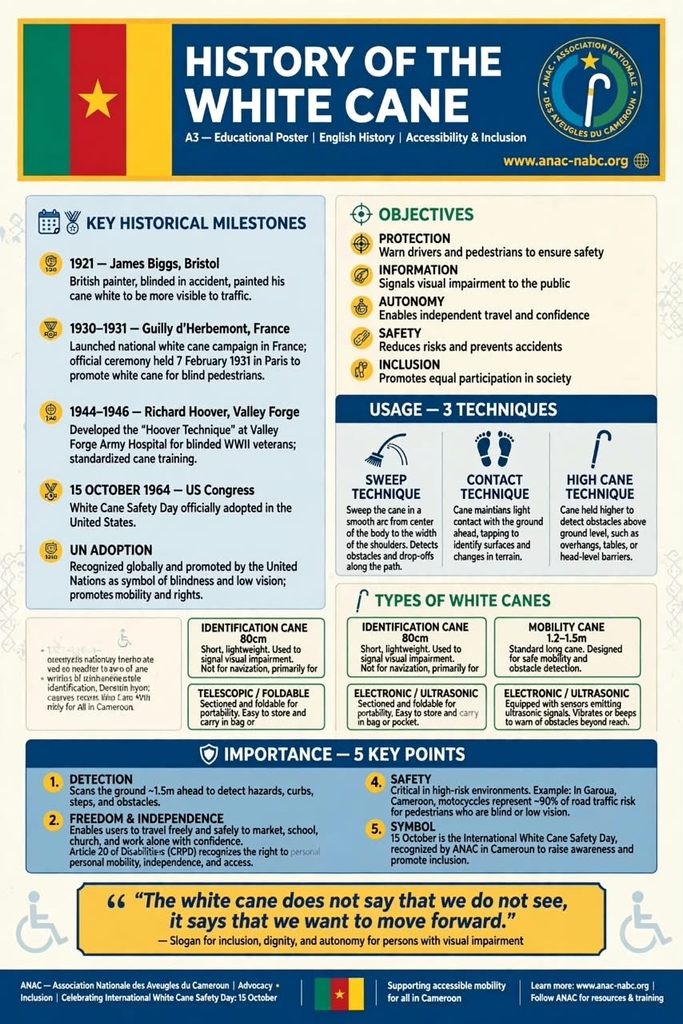
1921 – The original idea: James Biggs, a photographer in Bristol (England), becomes blind after an accident. He paints his cane white to be more visible to motorists in traffic.
1930 – Officialization in France: Guilly d’Herbemont, faced with dangerous traffic in Paris, offers white canes to blind people and obtains authorization from the Prefect of Police. On February 7, 1931, she organizes an official ceremony with the presence of several ministers.
1944-1946 – The modern long cane: Richard Hoover, American ophthalmologist at Valley Forge Hospital for blind war veterans, develops the long cane technique for mobility. It is the Hoover Technique that we use today.
October 15, 1964: The US Congress proclaims October 15 International White Cane Day (White Cane Safety Day), subsequently adopted by the UN.
2. OBJECTIVES
Protection: Detect obstacles on the ground, uneven surfaces, holes
Information: Inform the public that the person is visually impaired
Autonomy: Allow independent movement without a guide
Safety: Be visible to drivers and obtain right of way
Inclusion: International symbol recognized in all countries
3. USE – THE 3 TECHNIQUES
a) Sweeping technique (the most used) Cane held in the center of the body, sweeping from left to right at shoulder width, in rhythm with steps. The tip touches the ground just in front of the opposite foot.
b) Contact technique For cluttered environments: the cane is kept in permanent contact with the ground to better feel the reliefs.
c) High cane technique (in familiar environment) Cane held higher to detect obstacles at chest height.
Types of canes:
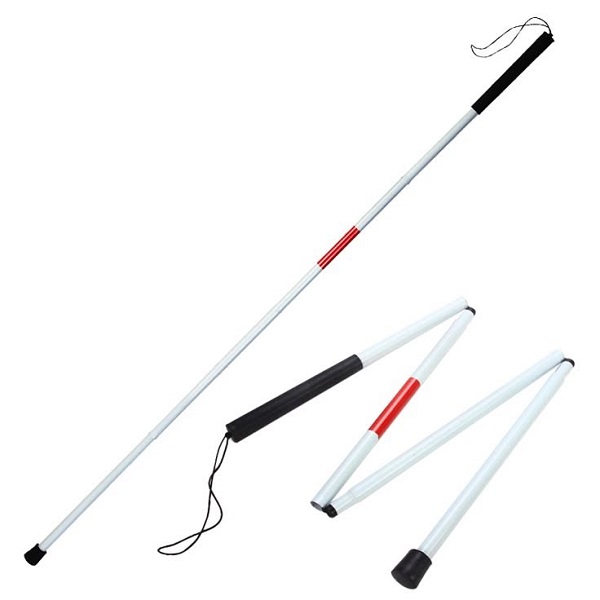
Identification cane (short, 80cm): only signals
Mobility cane (long, 1.20m-1.50m): for moving around
Telescopic / foldable cane: practical to store
Electronic cane: with ultrasonic sensor (modern)
4. IMPORTANCE – WHY IT IS VITAL
For us at ANAC, the white cane is:
It is our eyes on the ground: It replaces 1.5m of vision in front of us
It is our freedom: Without a cane, we depend 100% on a third person. With it, we go to the market, to school, to church alone
It is our right: Article 20 of the UN Convention on the Rights of Persons with Disabilities – right to mobility
It is our safety in Garoua: With motorcycle traffic, without a visible white cane, accident risk = 90% higher
It is the symbol of the October 15 Day that ANAC celebrates every year
ANAC Proverb: “The white cane does not say that we do not see, it says that we want to move forward.”